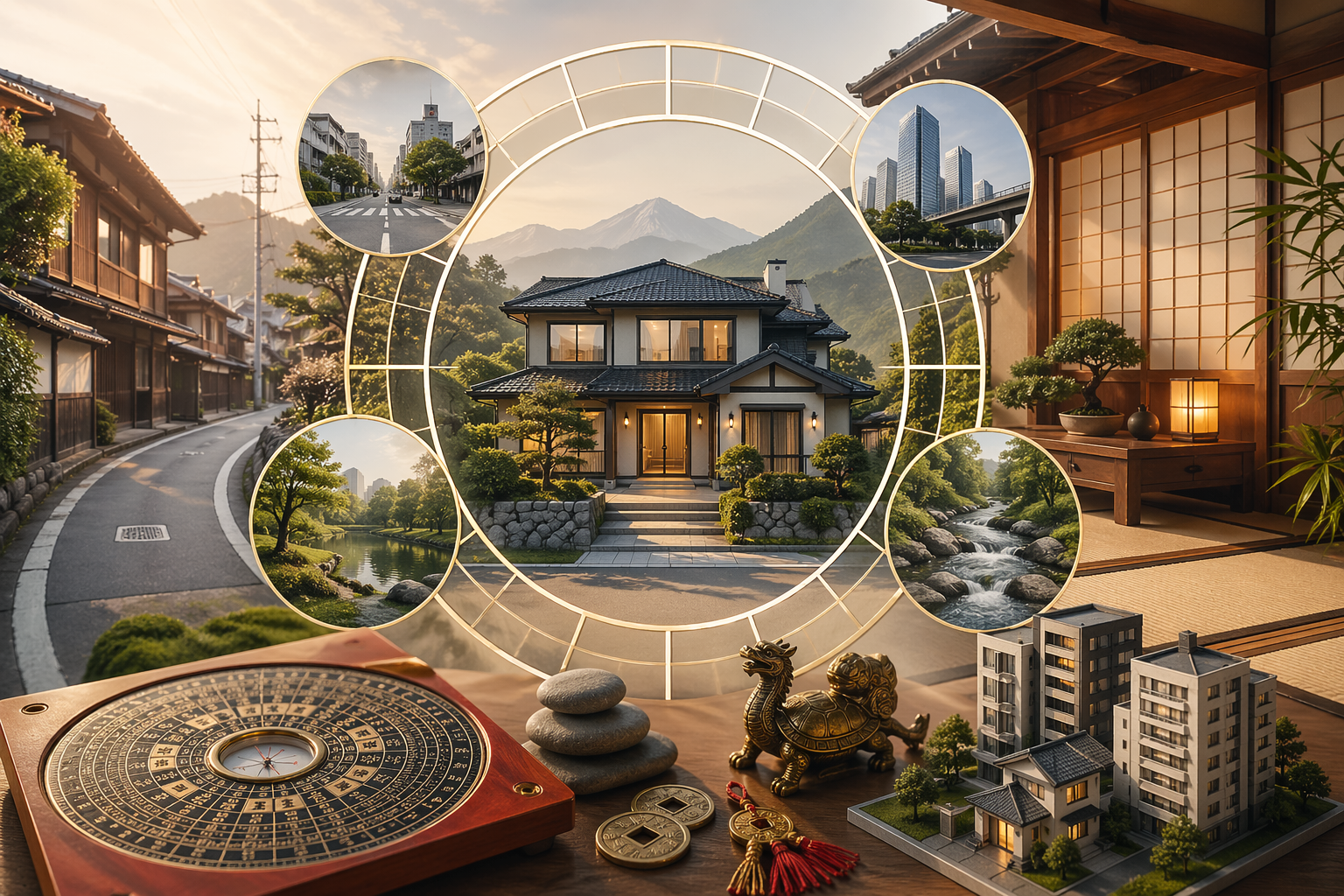
The Hidden Feng Shui Factors That Affect Property Value in Japan
The Hidden Feng Shui Factors That Affect Property Value in Japan
When investors evaluate real estate in Japan, they often focus on metrics like location, yield, and building age. But there’s a quieter, often overlooked layer that can significantly influence both desirability and long-term returns according to Feng Shui.
In a market where subtle perceptions shape buyer behavior and rental demand, Feng Shui isn’t just philosophical— it can directly impact your ROI.
1. Road Positioning: The Flow of Opportunity (or Risk)
In Feng Shui, roads are seen as channels through which energy—or qi—flows.
T-junction properties 丁字路口 (where a road points directly at the building) are often considered unfavorable. The fast-moving energy can create a sense of pressure or instability.
Properties inside curved roads, on the other hand, allow energy to accumulate more harmoniously, making properties feel safer and more inviting.
Investment Insight:
Properties on aggressive road alignments may be priced lower or stay longer on the market. While this can present a buying opportunity, it may also affect resale appeal and tenant retention.
2. Nearby Structures: What Surrounds You Matters
The environment around a property plays a major role in its perceived energy.
Proximity to cemeteries, hospitals, or elevated highways and train tracks can create psychological discomfort—even among tenants who aren’t consciously aware of Feng Shui.
Conversely, properties near parks, water features, or open spaces tend to feel more balanced and desirable.
Investment Insight:
In Japan, where neighborhood reputation is critical, surrounding structures can quietly influence rental demand and long-term appreciation. A property next to a park may command higher rents and attract longer-term tenants.
3. Building Age: Energy Imprint and Renewal
Japan’s real estate market already places strong emphasis on building age, but Feng Shui adds another dimension.
Older buildings may carry stagnant or outdated energy, especially if poorly maintained.
Renovations, natural light improvements, and updated entrances can “reset” the energy and increase appeal.
Investment Insight:
A well-renovated older property can outperform expectations—not just visually, but energetically—leading to stronger tenant satisfaction and reduced vacancy rates.
4. Entrance and Energy Flow: First Impressions Drive Value
The entrance is where energy—and opportunity—enters the home.
A bright, clean, and welcoming entrance encourages positive flow.
Narrow, dark, or cluttered entryways can block energy and create a subtle sense of discomfort.
In Japanese homes, the genkan (玄関) plays a particularly important role as the transition between outside and inside, with a culture of taking off our shoes, a sign of respect toward the inner sanctuary.
Investment Insight:
Small upgrades—lighting, decluttering, or design improvements—can significantly boost perceived value and rental appeal without major capital expenditure.
5. Layout and Interior Flow: Livability Equals Profitability
Feng Shui places strong emphasis on how energy moves within a space.
Good layouts allow for smooth movement between rooms, natural light, and functional living.
Problematic layouts (awkward angles, blocked pathways, or poorly placed kitchens/bathrooms in relation to the main areas of the house) can disrupt flow and reduce comfort.
Investment Insight:
Tenants may not articulate “bad Feng Shui,” but they will feel it. Properties with intuitive layouts rent faster, retain tenants longer, and ultimately generate more stable income.
6. Water Elements and Symbolism
Water represents wealth in Feng Shui.
Properties near (but not directly in front of) rivers, lakes, or the ocean are often associated with prosperity—only if the water flow is calm and well-positioned.
Poorly managed water (e.g., flooding risk or dirty canals) can have the opposite effect.
Investment Insight:
Water proximity in Japan can be a double-edged sword. When aligned with both Feng Shui principles and practical considerations, it can significantly enhance property value.
Bridging Feng Shui and ROI
For modern investors, Feng Shui should not replace financial analysis—it should enhance it.
By incorporating Feng Shui insights into your property selection process, you can:
Identify hidden risks that affect resale and rental demand
Spot undervalued properties with correctable Feng Shui issues
Enhance property appeal through low-cost improvements
Build a portfolio that supports both financial and emotional satisfaction
Final Thoughts
In Japan’s nuanced real estate market, success often lies in understanding what others overlook. Feng Shui offers a unique lens—one that blends cultural awareness, psychology based on environmental science, and spatial design.
Properties that “feel right” tend to perform better. Although there is no such thing as a "perfect property" that ticks all the boxes for good investment, in the long run, that feeling translates into higher occupancy, stronger demand, and better returns.
For investors seeking an edge, Feng Shui isn’t just tradition—it’s strategy.