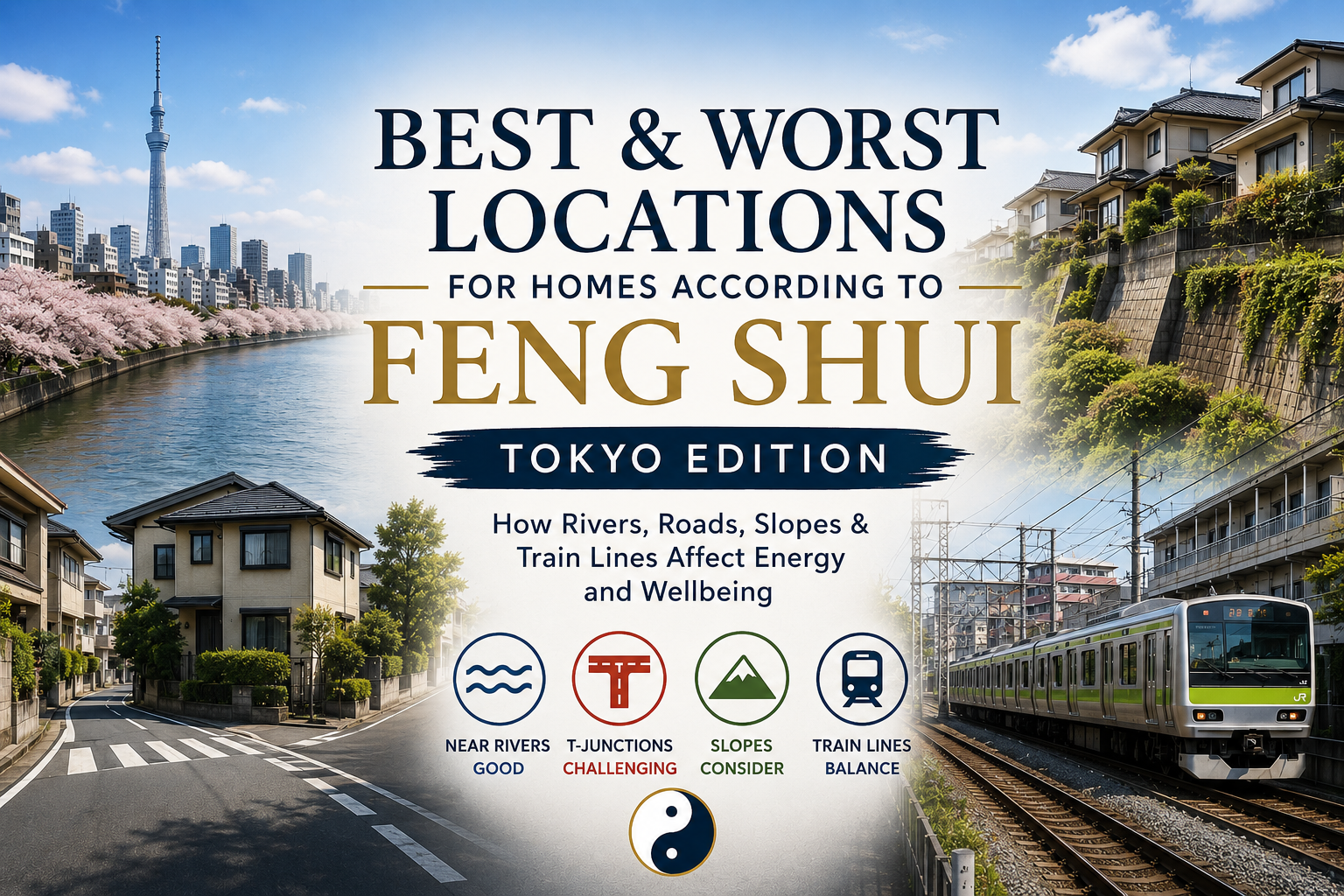
Best and Worst Locations for Homes According to Feng Shui (Tokyo Edition)
How Rivers, Roads, Slopes, and Train Lines Influence Energy, Lifestyle, and Property Appeal
When buying a home in Tokyo, most people focus on practical considerations: commute time, neighborhood reputation, school access, investment potential, or resale value.
But in Feng Shui, one of the most important questions comes before the floor plan or interior design:
How does the surrounding environment influence the home?
Classical Feng Shui has always emphasized the relationship between people and the land. Long before modern urban planning existed, practitioners studied mountains, water, wind patterns, and natural formations to determine where people would thrive.
Today, in a dense urban environment like Tokyo, these same principles can still apply — but interpreted through a modern lens. Rivers, roads, elevation, and infrastructure all influence the movement of qi (energy) and, just as importantly, how a home feels to live in.
Interestingly, many Feng Shui principles overlap with practical environmental factors such as sunlight, noise, airflow, privacy, and psychological comfort.
Here is a Tokyo-specific guide to some of the best and most challenging home locations according to Feng Shui.
1. Homes Near Rivers: A Symbol of Opportunity — With Balance

In classical Feng Shui, water represents wealth, opportunity, and life force.
Historically, thriving communities often developed near water because rivers brought transportation, commerce, and prosperity. As a result, homes positioned near calm, flowing water were considered beneficial.
In Tokyo, riverfront neighborhoods around areas such as the Meguro River or parts of the Sumida River are often desirable for their openness, scenery, and sense of space — something increasingly valuable in a dense city.
What Makes a River Location Favorable?
In Feng Shui, the ideal water flow is gentle and supportive.
A calm river nearby is believed to encourage smooth opportunities and a steady flow of positive energy. Open views and natural light can also contribute to a greater sense of wellbeing.
From a lifestyle perspective, riverside homes often benefit from:
Better visual openness
Improved airflow
Increased sunlight exposure
A calming atmosphere

When River Locations Become Less Ideal
Not every riverside property offers the same balance.
A home positioned too close to fast-moving water, sharp embankments, or low-lying flood-prone land may feel less stable — both practically and energetically.
For Tokyo buyers, it is always worth evaluating elevation, drainage, and flood risk alongside Feng Shui considerations.
In Feng Shui, water should support the home — not overwhelm it.

2. Homes Near Major Intersections (T-Junctions)
When Roads Become Rivers of Energy
In modern Feng Shui, roads are often considered the urban equivalent of rivers or streams — pathways through which energy flows.
In traditional landscapes, Feng Shui practitioners observed how rivers curved through valleys and how natural movement affected settlements. In cities like Tokyo, roads and traffic patterns are viewed similarly.
A quiet residential street may resemble a slow-moving stream, creating calm and stable energy.
A large road, however, can behave like a fast-moving river, bringing stronger, more active energy into the surrounding environment.

Why T-Junction Homes Are Often Considered Challenging
One of the most recognized Feng Shui concerns is a home positioned directly at a T-junction, where a road points straight toward the property.
In Feng Shui, this is believed to create rushing qi — energy moving too directly and forcefully toward the house instead of circulating gently around it.
Interestingly, this often aligns with practical real-world concerns in Tokyo:
Vehicle headlights entering windows at night
Increased visual stimulation from traffic movement
Noise and vibration
Reduced privacy
A sense of exposure rather than protection
Many people intuitively feel more comfortable in homes that feel sheltered rather than directly “hit” by movement.
Not Every Intersection Is Problematic
Context matters.
A home near an intersection may still feel balanced if there are trees, setbacks, landscaping, walls, or neighboring structures that soften the flow of energy.
Much like water naturally slows around curves, Feng Shui favors environments where movement is moderated rather than overwhelming.

3. Homes on Hills and Slopes
Tokyo’s landscape is more varied than many people realize.
Areas in western Tokyo and elevated residential districts often sit on hills or gradual slopes, which can influence both Feng Shui and long-term livability.

Why Elevated Ground Is Often Preferred
In classical Feng Shui, a home with supportive elevation behind it is seen as beneficial.
Symbolically, higher ground can represent stability, protection, and support.
Practically speaking, elevated areas often offer:
Better drainage
Improved sunlight exposure
More privacy
Reduced flood concerns
Open views
This is one reason many hillside residential neighborhoods in Tokyo feel quieter and more exclusive.
When Slopes Become Challenging
A home positioned awkwardly on a steep slope may create an impression of instability.
Steep land can introduce practical considerations such as:
Water runoff issues
Retaining wall maintenance
Limited outdoor usability
Reduced accessibility
From a Feng Shui perspective, excessively steep terrain may cause energy to move too quickly rather than settle comfortably around the home.
The ideal is gentle support, not dramatic imbalance.
4. Homes Near Train Lines: Convenience vs. Calm
Tokyo’s rail network is one of the city’s greatest advantages.
For many buyers and investors, station proximity is a major selling point. But there is an important distinction between living near transport and living directly beside it.

Why Train Lines Matter in Feng Shui
In Feng Shui, excessive movement and constant stimulation are often viewed as disruptive to rest and balance.
Train lines represent powerful movement — speed, vibration, and constant activity.
While this energy may support convenience and productivity, too much intensity can make a home feel less restorative.
Practical Considerations
Homes directly beside train lines may experience:
Noise pollution
Vibration
Reduced privacy
Constant movement in the environment
For many Tokyo residents, convenience outweighs these drawbacks.
However, from both a Feng Shui and lifestyle perspective, homes located a short walk from stations but slightly removed from major rail activity often strike the best balance.
The goal is accessibility without sacrificing peace.

So, What Makes a “Good” Home Location in Tokyo?
The best Feng Shui is rarely about perfection.
Instead, it is about balance between movement and stability, openness and protection, convenience and calm.
Many of the most desirable homes in Tokyo share similar characteristics:
✔ Quiet streets with good accessibility
✔ Gentle natural light and airflow
✔ Stable, well-positioned land
✔ Some separation from major infrastructure
✔ Greenery or visual openness nearby
✔ A feeling of calm when entering the property
Feng Shui should not replace practical due diligence, inspections, or market analysis.
But it can offer another valuable perspective — one that asks not only:
“Is this a good investment?”
But also:
“Will this home feel supportive to live in over time?”
In a city as dynamic as Tokyo, the best homes are often those where location, environment, and energy feel naturally aligned.