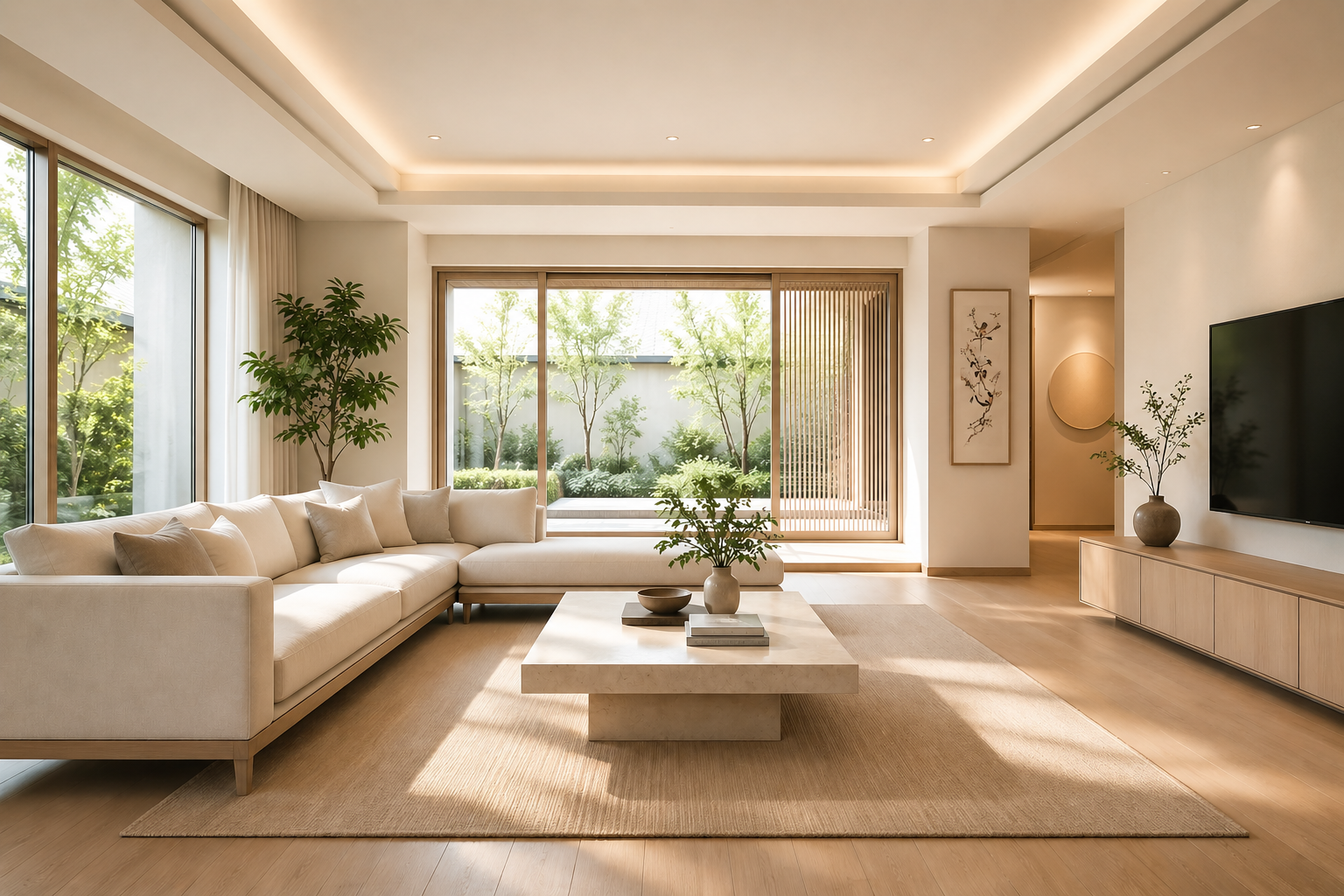
Why Some Homes Just Feel Right: The Psychology Behind Feng Shui
Why Some Homes Just Feel Right:
The Psychology Behind Feng Shui
Have you ever walked into a home and immediately felt at ease—like everything just clicked? No obvious reason, no dramatic feature—just an inner sense of comfort and clarity.
That feeling isn’t accidental. It’s the intersection of ancient Feng Shui principles and modern environmental psychology—a subtle but powerful relationship between space and the human mind.
This blog article explores why certain homes “feel right,” translating Feng Shui into a language we can appreciate: human behavior, perception, and neuroscience.
The Brain Is Always Reading a Room
Before you consciously form an opinion about a space, your brain has already scanned it for safety, comfort, and usability. This process is deeply rooted in evolutionary psychology.
We instinctively prefer environments that offer:
Clear visibility (we can see who or what is around us)
Defined boundaries (we feel protected, not exposed)
Logical flow (we can move easily without friction)
In Feng Shui, this aligns closely with the concept of “qi flow”—the idea that energy should move smoothly through a space without obstruction.
A cluttered 'genkan' home entrance, a narrow hallway filled with obstacles, or furniture blocking movement creates subtle stress signals in the brain. You may not consciously notice it, but your body instinctively does.
Layout and the Psychology of Control
One of the most powerful overlaps between Feng Shui and psychology is the idea of control.
In Feng Shui, the “command position” suggests placing key furniture—like beds, desks, and sofas—where you can see the entrance without being directly in line with it.
Psychologically, this matters because:
Seeing the entrance reduces anxiety by knowing who enters/exits the space
It gives a sense of awareness and preparedness to anyone approaching you
It reinforces subconscious feelings of safety
This is why sitting with your back to the door in a café often feels uncomfortable, even if you can’t explain why.
A well-positioned bed or desk doesn’t just follow tradition—it aligns with how the brain defines security.
Natural Light: More Than Just Aesthetic

Natural light is one of the most universally appreciated features in any home—and for good reason.
From a psychological perspective, exposure to natural light:
Regulates hormones for circadian rhythms (sleep cycles)
Boosts mood and productivity
Reduces stress and fatigue
In Feng Shui, light is considered a carrier of positive "yang" energy. Dark, poorly lit spaces are associated with stagnant or "yin" qi.
In dense urban areas like Tokyo, where space and sunlight can be limited, even small adjustments—like sheer curtains, mirrors, or strategic furniture placement—can significantly improve both light flow and emotional well-being.
Clutter, Cognitive Load, and Mental Fatigue

Clutter is more than a visual issue—it’s a cognitive one.
Studies in environmental psychology show that clutter:
Increases cortisol (stress hormone)
Reduces focus and decision-making ability
Creates a sense of overwhelm
Feng shui has long emphasized the importance of decluttering, especially in transitional spaces like the entrance (genkan). These areas set the tone for how energy—and psychologically, attention—flows into the home.
A clean, intentional space allows the brain to relax. A chaotic one forces it to work harder.

Proportion, Balance, and Visual Harmony
Humans are naturally drawn to balance and proportion. This is why symmetrical layouts, aligned furniture, and consistent spacing feel “right.”
Feng shui reinforces this through:
Balanced placement of objects
Avoidance of extreme visual weight on one side
Harmonizing elements (wood, fire, earth, metal, water)
From a psychological standpoint, balanced environments:
Reduce visual tension
Improve processing fluency (things are easier to understand)
Create a sense of stability
This is also why overly cramped or awkwardly arranged Tokyo apartments can feel stressful—even if they’re stylish.
The Emotional Language of Materials and Color

Materials and colors communicate directly with our emotions.
Soft, natural materials (wood, linen, stone) evoke warmth and calm
Harsh, reflective surfaces can feel cold or overstimulating
Neutral tones promote relaxation, while bold colors stimulate energy
Feng Shui categorizes these into the five elements, each influencing mood and energy in different ways.
Modern psychology agrees: environments rich in natural textures and balanced colors are associated with lower stress and higher well-being.
Why Feng Shui Still Matters Today
It’s easy to dismiss Feng Shui as superstition—but when translated through psychology, its principles become surprisingly practical.
At its core, Feng Shui is about:
Reducing friction in how we live and move
Creating environments that support mental clarity
Designing spaces that align with human instincts
In fast-paced urban environments like Tokyo, where homes are often compact and multifunctional, these principles become even more relevant.
A well-designed space doesn’t just look good—it feels right because it supports how we think, move, and rest.
Final Thoughts
The reason some homes feel instantly comfortable isn’t magic—it’s alignment.
Alignment between:
Space and movement
Light and biology
Layout and psychology
Feng Shui simply recognized these patterns long before modern science gave them names.
So the next time you walk into a home and feel that quiet sense of ease, trust it.
Your brain has already done the analysis.
And with a few intentional adjustments, you can create that same feeling—by design.